SEPTEMBER 2025
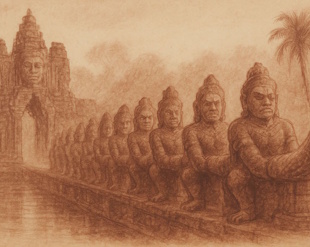
A special edition dedicated to Tây Ninh province and to the Bodhisattvas.
THE BLACK VIRGIN MOUNTAIN
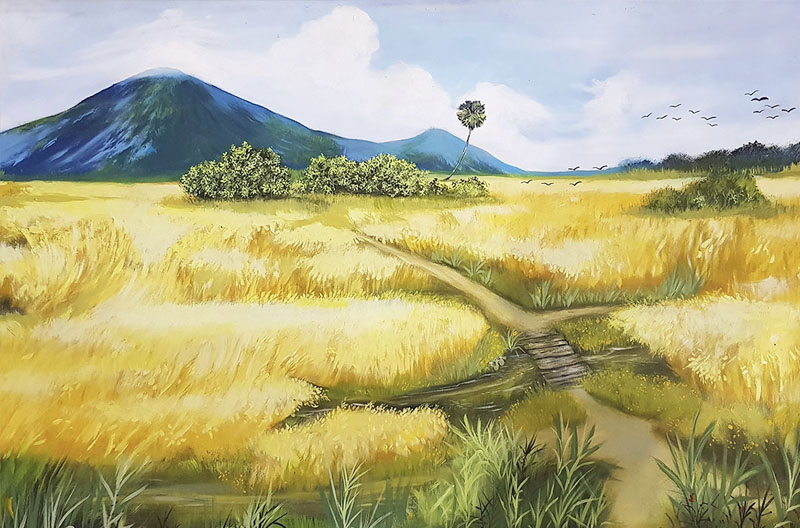
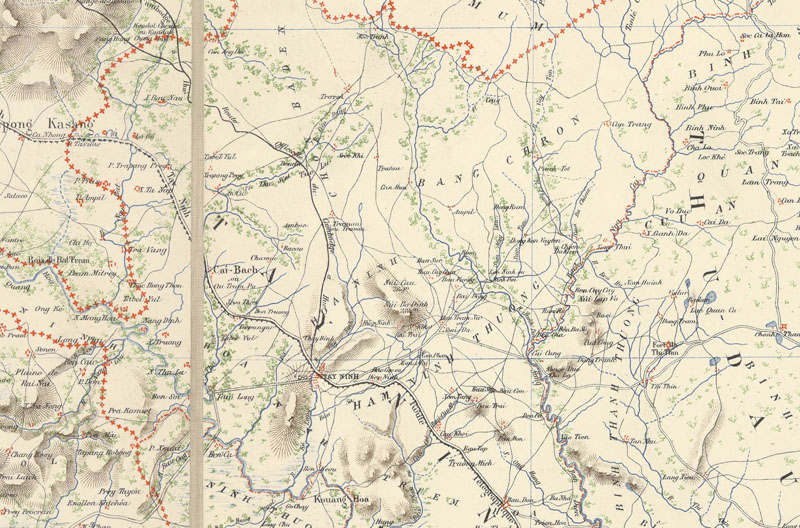
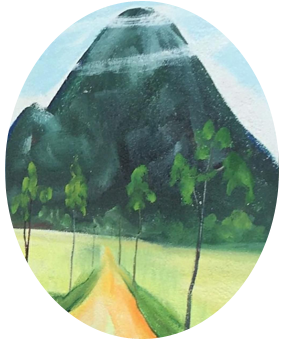
The Black Virgin Mountain, Nui Ba Den, the Phnom Chol Baden of the Cambodians, has been revered since time immemorial as the seat of a local tutelary deity of Cambodian origin. The mountain is an ancient volcano extended by two other mounts, Nui Heo and Nui Voi (Nui Phung).
Nui Ba Den is an inselberg, an isolated relief dominating a relatively flat plain. Formed some 60 to 100 million years ago during the Upper Cretaceous period in a tectonically and volcanically active context, it is the result of the slow solidification of magma beneath the surface (plutonism), forming a mass of highly resistant granite. Over millions of years, erosion wore away the surrounding terrain, revealing this massive granite core as a rocky island dominating the plain. The rocks are dense, erosion-resistant, light grey to pinkish in color, and they contain mainly quartz, alkali feldspar and biotite. In the humid tropical climate, chemical decomposition processes (hydrothermal alteration) shaped rounded rocks (typical erosion balls), overhangs, detached boulders and pockets of red laterite on the lower slopes. The volcano appears massive and solitary, with steep, sometimes abrupt slopes and localized cliffs. The summit forms a small plateau covered with scattered boulders.
Clear streams gush forth from its hills, particularly during the rainy season. Several of these are considered sacred and are associated with local legends or places of prayer. The most notable are Suoi Da (stone stream), Suoi Vang (golden stream), Suoi Ong Ho (tiger stream) and Suoi Lua (fire stream), whose red quartz-flecked stones sometimes cause the stream to glitter like a tongue of fire.
On Nui Ba Den’s steep slopes, between moss-covered granite boulders, lie the remains of the dense tropical forest that once covered the mountain. A few hundred-year-old dipterocarps still stand, their trunks bearing lianas and hanging orchids. On the ground, bare roots snake over carpets of crunching dead leaves, bluish mushrooms hide under stones, twisted bamboos creak in the south wind, and red flamboyants bleed in April. Wild guava trees perch on rocky slopes and a forgotten orchid appears here and there, a discreet witness to an ancient time. Various bird species nest on the mountain, including bulbuls, bee-eaters, shrikes, solitary buzzards and migratory species such as herons.
There are various legends about Nui Ba Den. One of the oldest, a Khmer myth, involves a female deity, the Neang Khmau, who is said to have left her footprints on the rocks and faces of the mountain.
The primordial mountain spirit is the oldest, animist version. Long before temples or men, there was a naked, proud, silent mountain. Later, the Khmers and local Proto-Indochinese groups spoke of an ancient, fierce female spirit who inhabited the peak. She was neither human nor goddess, but guardian of wild forces, protector of births and deaths, and mistress of storms and harvests. She was invoked by burning precious woods, sacrificing buffaloes and black roosters. The elders said that she would unite with the clouds and howl at the full moon if the people forgot to honor her.
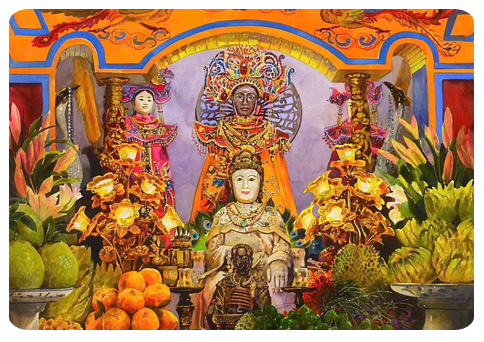
When organized religions arrived, the spirit kept quiet for a while, before joining in with the new cults. The bonzes said: “She's not a goddess, she's a Bodhisattva in the making.” But in simple hearts, she remained the Old Mother, Ba Co, the all-seeing one. Buddhist tradition sees her as the reincarnation of the Bodhisattva Kwan Am, the Goddess of Compassion. Having seen too much suffering on the plains of the Mekong, she chose to reincarnate on this mountain where she welcomed prayers, sorrows and hopes. Every rock would be an ear, every breeze a mantra. Her choice of a brown, austere form, without dazzling beauty, would be a lesson in humility and inner purity.
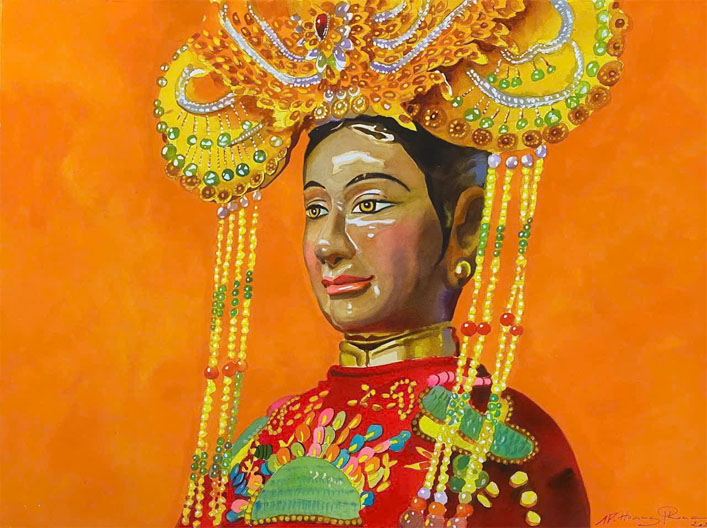
The best-known, most modern version evokes Ly Thien Huong, the martyr of love and faith. At the time of the Nguyen lords, a young girl of rare beauty and ardent Buddhist faith named Ly Thien Huong lived in Trang Bang. Her skin was as dark as black lotus seeds, her eyes as clear as spring water. The villagers affectionately nicknamed her Ba Den. One day, she met a young scholar, Le Si Triet, at Linh Son temple. They fell in love, pure love, but their union was cursed by jealous nobles. When he left to study far away, she was left alone to pray on the mountain. One day, attacked by bandits on the mountainside, she chose to throw herself into the void rather than lose her honor. According to legend, the rocks wept, the clouds descended to cover her, the Buddha sent a glow to gather her soul, and the pious made pilgrimages there.
Pilgrims to the Black Virgin – then simple folk, monks, hermits, traders or peasants from the forest – followed red earth paths winding through tall grass and forests, linked by the murmur of ritual drums and bronze bells. These columns of pilgrims from Cambodia or the deltaic regions headed for the mountain that rose above the forest like a finger of stone between heaven and earth, the sacred mountain (in ancient Khmer Phnom Preah Vihear Thmei, the mountain of the new sanctuary). Forest shamans and monks said it was the home of a discreet goddess, guardian of the passage between worlds.
Every year, in the dry season, a silent procession crossed the lowlands, led by barefoot bonzes. They carried on their shoulders small statues of Buddha, Shiva or ancient goddesses, depending on their faith. Ritual stops were punctuated by chanting in Pali and Khmer, offerings of incense, palm sugar and gold leaf, and nights under the moon listening to stories passed down by the elders. It was said that whoever reached the mountain without averting his eyes from its summit would gain clarity of mind and appeasement of heart.
On the road to the Black Virgin Mountain – across the plains of present-day Ben Cau, Go Dau or Trang Bang –Khmer brick temples stood here and there, sometimes half-engulfed by vegetation, sometimes restored by itinerant monks. At the time, they were linked by red earth tracks through immense forests dotted with small clearings where the buildings stood, and Buddhist temples and salas were grafted onto them. These were red-brick sanctuaries, decorated with geometric and floral motifs, surrounded by giant trees. People stopped to recite mantras, while women placed rattan bracelets and frangipani flowers on them. The end of the pilgrimage was the winding path up to the summit of the Black Virgin, where a small temple was the object of much veneration.
During the Second World War, the mountain was occupied by the Japanese, then by the Viet Minh, the French, and the Viet Cong, and its surroundings were the scene of clashes during the Vietnam War. Its summit was first captured by Special Forces during a helicopter assault in May 1964. The U.S. army built a highly complex two-hectare camp among the rocks and boulders at the summit of Nui Ba Den. In November 1967, the U.S. Army's 25th Infantry Division took over from the Special Forces and the Civilian Irregular Defense Group to monitor the radio installations. Nui Ba Den became a sensitive and secret military communications station, used as a listening post to pick up enemy signals and direct air raids. Personnel and equipment for numerous units of the 25th Infantry Division and non-divisional units were administered by Company “D” of the 125th Signal Battalion. The main unit atop Nui Ba Den was the 372nd Radio Relay Unit (RRU) of Sobe, Okinawa, a special section of the U.S. Security Agency.
But on the night of May 13, everything changed. The mountain was asleep, when around midnight, the American sentries first saw points of light appearing in the thicket, like fireflies. The silence was broken by a thunderous explosion; mortar fire rained down like black rain, and the eastern flank of the summit burst into flames. Vietnamese forces, made up of trained Viet Cong fighters, emerged from the wooded slopes, some climbing, others passing through the forgotten rock tunnels that were the legacy of monks and hermits of yesteryear. The American soldiers were overwhelmed. Panic-stricken, they fired back in all directions, but the assailants seemed to emerge from the rocks themselves. Hand-to-hand combat ensued in radio sets, trenches, and metal barracks. An explosion ripped open the main bunker. At dawn, silence fells again. The ground was black with ashes and red with blood. The camp was all but wiped out. Some 30 American soldiers were killed. The haggard survivors were airlifted out, while the Vietnamese fighters retreat into the shadows, disappearing into the mountain like specters. The summit was later retaken by the Americans, but fear remained.
After the war, Black Virgin Mountain continued to be a major pilgrimage site in southern Indochina. Between 2018 and 2020, SunWorld Group built a cable car and landscaped the summit, including constructing the famous large statue.
There are three main festivals dedicated to the Black Virgin, the Vesak, and the monsoon. The Black Virgin Festival is held every year during the full moon of the first lunar month. (In 2026, it will take place from January 29 to February 2, 2026, culminating on February 1, 2026). The biggest of the three festivals, thousands of pilgrims climb the mountain or take the cable car up to the main temple of Ba Den. Offerings of incense, flowers, fruit, and food are placed at the shrine. Dances, collective prayers, and sometimes nocturnal processions are held here. Buddhist rituals are also held in adjacent temples (Trung pagoda, Hang pagoda, Ha pagoda). The Vesak Festival, a major Buddhist festival celebrating the birth, enlightenment and death of Gautama Buddha, takes place on May 1, 2026. Rituals include ceremonies in Buddhist pagodas on the summit and southern slopes, offerings, sutra readings and bathing of the Buddha statue. Lanterns are hung in the trees or placed on the small Zen ponds. The third festival marking the arrival of the monsoon and the beginning of rice planting is less formal, observed locally in late April or early May. Prayers are made to the Black Virgin for a bountiful harvest, involving rituals in the villages at the foot of the mountain.
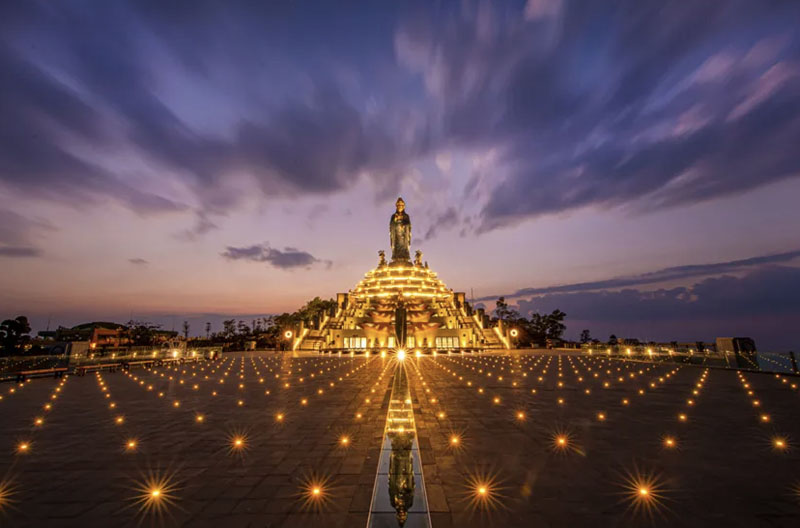
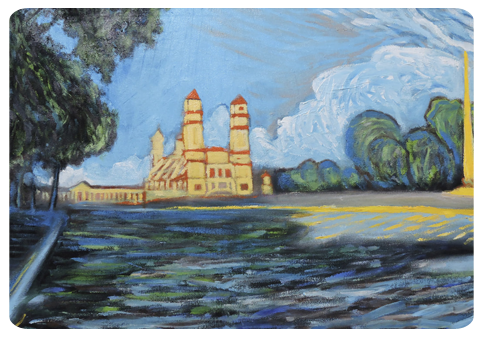
The great statue of the Black Virgin and its summit esplanade.
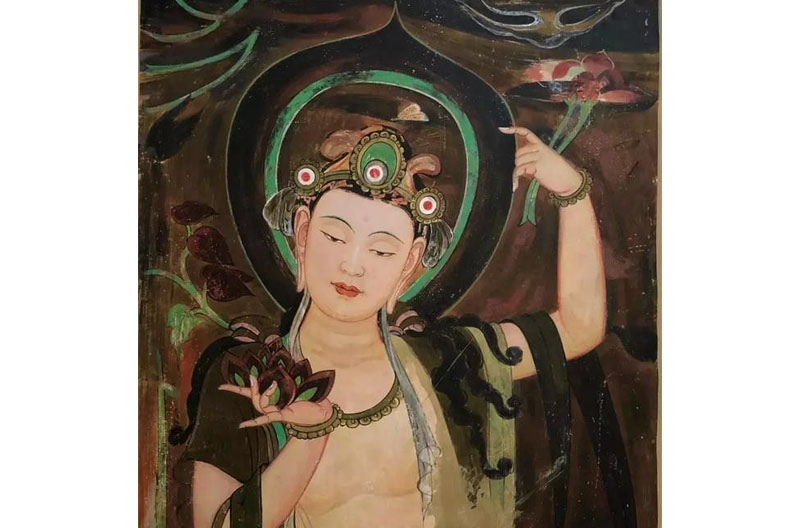
YEAY MAU BIRTH AND REPRESENTATION OF A DIVINITY
In a seminal article, Paul Mus (1933) evokes this "true religion of Asia, that of the soil" of which the Neak Ta are the eminent representatives. The Neak Ta – a term translated as "Ancestors", "tutelary deities", "protective deities," and others – are omnipresent in the Khmer space, and they constitute its true spiritual structure.
If the traveler manages to look away from the Angkorian temples or Buddhist pagodas for a moment, he will see a hut with a statue inside with attributes, often a stick and an explanatory caption "the genius with the stick of precious stones" or "the genius with the iron stick," etc. These deities are still the object of worship; it is important not only to protect oneself from natural disasters, but also to obtain a good harvest and protection for the clan or village.
It is precisely within this cult space that Yeay Mau exists.
A coastal legend
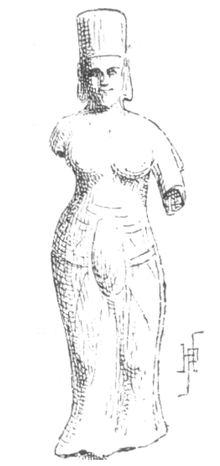
Yeay means "grandmother, old woman," and Mau is a person name derived from the Khmau "black, dark." The name Yeay Mau is often preceded by the respectful term "Lok," generally attributed to the Neak Ta.
“There was a sailor who used to sail along the coast from here [Kep] to very far places. His wife, Mau, waited patiently for him to come back, sometimes for several months. One time he didn’t come back. It finally turned out that he had died in a storm. His young wife despaired not only because she truly loved him; but, because of his absence, she had to face strong sexual frustration, too. So here when people set sail, they offer her a wooden phallus to keep her quiet and to avoid her causing storms.”
Many other stories echo this version. Yeay Mau replaces her husband with a soldier who died in the war, Yeay Mau drowns in a storm while searching for her husband... but the underlying narrative structure remains, in all cases, the same: lack [sexual frustration] – warding off Yeay Mau's possible anger [offering of wooden phallus].
Originally, it was therefore a coastal cult consisting of offerings of small wooden phalluses to a spirit whose anger one did not want to provoke; in this coastal context, there was no anthropomorphic representation in the form of a statue.
From offerings to statuary representations
Anthropomorphic representations probably appeared later inland, although it is difficult to establish a chronology. The photograph depicts an altar built in the Cardamom Mountains. It shows a statue of Yeay Mau flanked by a large phallus on its right side (Filippi, 2008, 2012).
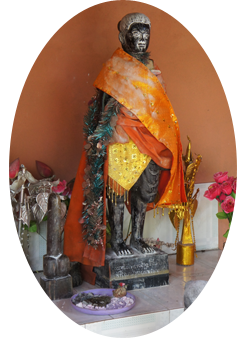
Only in recent years has this anthropomorphic representation conquered the coastal area. Today, altars with statues of Yeay Mau can be seen all along the coast, such as in Kep, where the legend probably originated.
Chronologically, we can ascertain the following cult sequence:
1. Wooden phallus on the coast
2. Erection of statues inland
3. Yeay Mau returns to the coast, this time in the form of statues
What does this sequence, presumably chronological, reveal to us about the deep nature of Yeay Mau?
From initial neutrality to the positive activity of Neak Ta
So, what role does Yeay Mau play?
The Yeay Mau of legend initially plays none of these roles. Placing phalluses on the beach is not a common way to worship a deity. Travelers and fishermen might demand something from Yeay Mau – a good journey, or a bountiful catch – but this is not the case. Other Neak Ta are there to satisfy these desires. As for Yeay Mau, she is not asked to act positively; quite the contrary, the phalluses are offered to her to ask her not to act, not to get angry, and not to cause storms.
Yeay Mau can be compared to the Preah Phum. It is a dimensionless point that comprehends the village as a set of houses. Since a point has no dimension, a wooden pillar is often used to mark the place where the point is supposed to be. Negative, neutral, deprived of any kind of positive function to such a point that Eveline Porée Maspéro could write:
“It is impossible to know what the Preah Phum represents. The word Phum designates the land on which the house is built and in the same time the smallest administrative unit. But the Preah Phum appears to be a very unclear entity: the real active part is played by the Neak Ta (Maspéro, 1962).”
The Preah Phum won’t be solicited for a better harvest; other local gods fulfill such a function. In cases of calamities such as numerous sudden deaths, epidemics or climate problems, however, the villagers may act on the Preah Phum through a number of ceremonies.
In contrast, the human figure representation is perfectly illustrated by the photo where Yeay Mau stands with a phallus on her right. Various offerings, including phallic symbols, incense sticks, etc., are used by the faithful, this time to solicit a positive attitude from Yeay Mau, whose protection is very often sought by travelers and, in times of war, by soldiers.
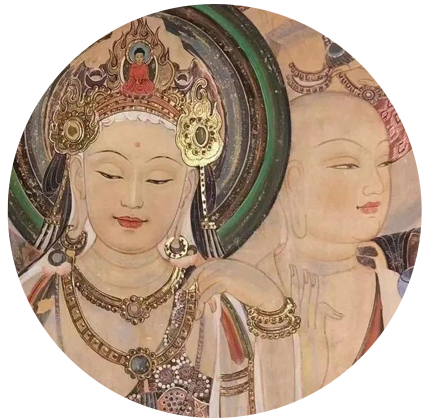
The most famous examples are found on National Highway N.4 between Phnom Penh and Sihanoukville. In Pech Nil, due to a dangerous bend that caused numerous road accidents, altars began to be built to house statues of Yeay Mau. A thriving industry of phallic symbols developed around this cult, until the local authorities decided to put an end to it, although wealthy "pilgrims" are still rumored to be allowed to discreetly offer copies of the linga made of sandstone and concrete.
The famous "Kampot Gate" is another prominent example. The heavy presence of Khmer Rouge soldiers in the 1990s made the Kampot region dangerous. While the city was relatively well protected, the Khmer Rouge laid ambushes on a pass overlooking the Kampot plain. The task of protecting travelers was assigned to Yeay Mau, to whom a superb temple was dedicated, featuring statues adorned with the usual attributes... including the ever-present phallus.
Conclusion
Yeay Mau is now present almost everywhere in Cambodia. Moreover, unlike the other Neak Ta, her presence adheres to a strict normative approach; for instance, Yeay Mau was never represented in the space of the pagoda. There are very few recent exceptions, such as Ream Pagoda, where a statue of Yeay Mau can be found, and this representation excludes phalluses.
Many narratives describe Yeay Mau’s religion as Brahmanism. This term (in Khmer Sahsana, priem literally refers to the religion of Brahma) is used to designate a number of religious practices different from Buddhism. The word was heard several times in surveys of the linguistic and ethnic situation in the Cardamom Mountain Chain, particularly in O Som commune (Filippi, 2008, 2012). The content of this religion is syncretic par excellence: ghost festivals in September, local gods, and… Yeay Mau always represented with a huge phallus. In the Cardamom Mountains, the phallus is a necessary part of the representation of Yeay Mau, and people do not worship her by offering phalluses.
In contrast to the passivity of the spirit in the legend, the representation of Yeay Mau in the form of a statue asserts a strong positivity. From now on, Yeay Mau is required to perform a certain number of actions, just like a Neak Ta. In other words, Yeay Mau has become a Neak Ta in her own right.
By J-M Filippi.
References
- Ang, Choulean. 2016. Yay Mau. In Le passé des Khmers, langue, textes, rites, edited by Nasir Abdoul-Carime, Grégory Mikaélian and Joseph Thach. Pages 249-262. Peter Lang.
- Ang, Choulean. 1986. Les êtres surnaturels dans la religion populaire khmère. Paris : CEDOREK.
- Filippi, Jean-Michel. 2008. Recherches préliminaires sur les langues des minorités du Cambodge. Phnom Penh: Funan et UNESCO.
- Filippi, Jean-Michel. 2012. A Research about Languages and Cultures in the Cardamom Mountains. Report presented to the UNESCO.
- Mus, Paul. 1933. L’inde vue de l’Est. Cultes indiens et indigènes au Champa, pp. 367-410, BEFEO, XXXIV, n.1.
- Porée-Maspero, Eveline. 1962. Etude sur les rites agraires des Cambodgiens. Paris: Mouton.

SEE ALSO OUR OTHER NEWSLETTERS